If you are learning machine learning or training your first neural network, you will frequently encounter the term epoch. Understanding what an epoch is—and how it relates to batches, iterations, and model performance—is essential for building accurate and efficient models.
In simple terms:
An epoch in machine learning is one complete pass of the entire training dataset through a model.
This guide explains the concept clearly, connects it to real training behavior, and shows how to choose the right number of epochs without overfitting your model.
Related Blogs:
What Is an Epoch in Machine Learning?
An epoch represents one full training cycle where every training example is used once to update the model’s weights.
Quick definition (featured-snippet ready)
An epoch is one complete pass of the full training dataset through a machine learning model during training.
Because most datasets are large and models learn gradually, training usually requires multiple epochs.
Epoch vs Batch vs Iteration: The Key Differences
These three terms are often confused, but they describe different levels of the training process.
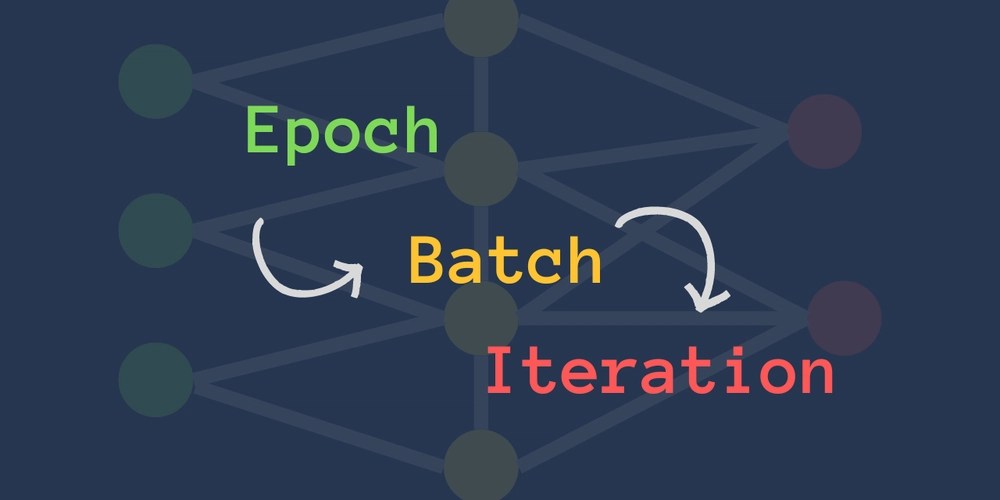
| Term | What It Means | Simple Analogy |
|---|---|---|
| Epoch | One full pass over the entire dataset | One full lap around a track |
| Batch | A subset of the dataset | A group of runners |
| Iteration | One weight update using one batch | One step taken during the lap |
Example
- Dataset size = 1,000 samples
- Batch size = 100
Then:
- Iterations per epoch = 1,000 ÷ 100 = 10
- 10 iterations = 1 epoch
Why Do We Need Multiple Epochs?
A single epoch is usually not enough for a model to learn meaningful patterns.
What happens during each epoch?
- Data flows forward through the network
- Predictions are made
- Error is calculated
- Backpropagation adjusts weights
- The process repeats with improved weights
This gradual improvement is driven by gradient descent, which optimizes the model step by step. Each epoch refines the weights further, helping the model converge toward better accuracy.
The “Goldilocks” Problem: How Many Epochs Are Enough?
Choosing the right number of epochs is critical.

Too few epochs → Underfitting
- Model stops learning too early
- High bias
- Poor training and validation performance
Too many epochs → Overfitting
- Model memorizes training data
- Validation loss increases
- Poor generalization to new data
The solution: Early Stopping
Early stopping monitors validation loss and automatically stops training when performance stops improving—preventing overfitting while saving compute time.
How to Calculate Epochs and Iterations (With Example)
This calculation appears frequently in exams and interviews.
Formula
Iterations per epoch = Total training samples ÷ Batch size
Example
- Training samples = 2,000
- Batch size = 200
- Epochs = 5
Then:
- Iterations per epoch = 2,000 ÷ 200 = 10
- Total iterations = 10 × 5 = 50
Epochs in Popular ML Libraries
Keras / TensorFlow example
model.fit(X_train, y_train, epochs=10, batch_size=32)
PyTorch epoch loop (conceptual)
for epoch in range(num_epochs):
    for batch in dataloader:
        train_step(batch)
Here, epochs=10 means the model will see the entire dataset 10 times during training.
Why Multiple Epochs Improve Learning
AI models rarely “understand” data in a single pass. Multiple epochs help:
- Reduce training error gradually
- Stabilize weight updates
- Improve convergence
- Capture complex, non-linear patterns
However, more epochs ≠ result in better results. Monitoring validation metrics is essential.
Frequently Asked Questions
What is the difference between an epoch and a batch?
An epoch uses the entire dataset once, while a batch is a small subset used in one iteration.
How many epochs should I use?
There is no fixed number. Start with 10–50 epochs, then adjust using validation loss and early stopping.
Why does validation loss increase after many epochs?
This is a sign of overfitting, where the model starts memorizing training data instead of learning general patterns.
Can too many epochs reduce accuracy?
Yes. Excessive epochs often degrade real-world performance due to overfitting.
Key Takeaways
- An epoch is one full pass through the training dataset
- Training typically requires multiple epochs
- Epochs, batches, and iterations work together
- Too few epochs cause underfitting; too many cause overfitting
- Early stopping helps find the optimal balance

