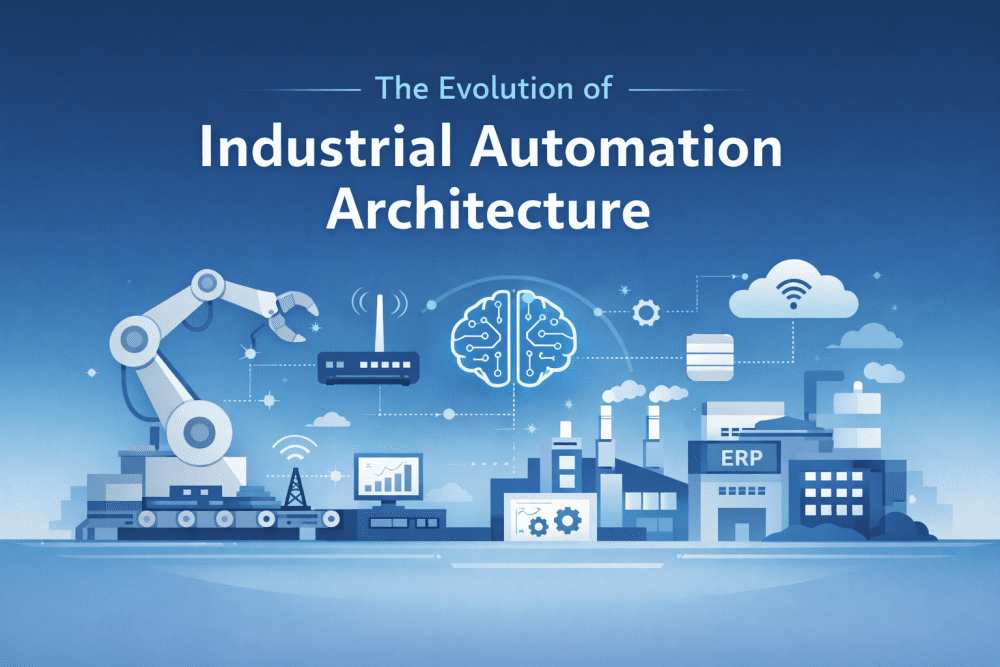
Industrial automation has evolved significantly over the last few decades. Traditionally, manufacturing systems followed a rigid hierarchical architecture, commonly represented by the ISA-95 automation pyramid. This model organized operations into structured layers ranging from field devices to enterprise management systems.
However, the industrial landscape in 2026 is rapidly shifting toward edge-integrated, AI-driven, and decentralized automation architectures. Smart factories now combine Industrial IoT (IIoT), edge computing, Unified Namespace (UNS), and Agentic AI orchestration to create adaptive and intelligent production systems.
This article explains the architecture of industrial automation systems, from the traditional automation pyramid to modern Industry 5.0 intelligent architectures.
Related blogs:
The Evolution of Industrial Automation Architecture

Industrial automation architecture defines how hardware, software, and networks interact to control industrial processes. It determines how data flows between sensors, control systems, and enterprise platforms.
Traditional Architecture (Industry 3.0)
Historically, automation followed a centralized hierarchical structure:
- Fixed control logic
- Limited connectivity between layers
- Manual decision-making
- Hardware-centric automation
Systems were primarily built using:
- Programmable Logic Controllers (PLC)
- Distributed Control Systems (DCS)
- Supervisory Control and Data Acquisition (SCADA)
While reliable, these architectures created data silos that limited real-time insights and scalability.
Modern Architecture (Industry 4.0 → Industry 5.0)
Modern factories now adopt a data-centric architecture that integrates:
- Industrial Edge Computing
- Unified Namespace (UNS)
- Agentic AI in manufacturing
- Hyperautomation orchestration
- Human-centric automation (cobots)
This approach allows machines to interpret high-level intents instead of executing fixed instructions, enabling autonomous and adaptive production systems.
The 5 Levels of the Automation Pyramid (ISA-95)

The ISA-95 standard defines a widely used model for industrial automation architecture. It organizes manufacturing operations into five hierarchical levels.
| Level | Layer | Components | Function |
|---|---|---|---|
| Level 0 | Field Level | Sensors, actuators | Capture physical data and execute mechanical actions |
| Level 1 | Control Level | PLC, RTU | Real-time control of machines and equipment |
| Level 2 | Supervisory Level | SCADA, HMI | Monitoring and operator control |
| Level 3 | Operations Level | MES | Production planning and workflow management |
| Level 4 | Enterprise Level | ERP, analytics platforms | Business planning, logistics, finance |
Explanation of Each Level
Level 0 – Field Devices
This level includes physical components such as:
- Temperature sensors
- Pressure sensors
- Motors
- Valves
- Actuators
These devices interact directly with the industrial environment.
Level 1 – Control Systems
At this level, Programmable Logic Controllers (PLC) interpret sensor signals and execute control logic. PLCs perform tasks such as:
- Machine control
- Safety shutdown mechanisms
- Process automation
Level 2 – Supervisory Systems
Supervisory systems provide visual monitoring and control through platforms like:
- SCADA
- Human Machine Interface (HMI)
Operators use these systems to monitor alarms, machine performance, and process metrics.
Level 3 – Manufacturing Operations
Manufacturing Execution Systems (MES) manage production workflows including:
- Production scheduling
- Quality control
- Maintenance planning
- Inventory tracking
MES acts as the bridge between operational technology (OT) and information technology (IT).
Level 4 – Enterprise Systems
Enterprise systems integrate manufacturing with business operations through:
- Enterprise Resource Planning (ERP)
- Supply chain management
- Financial planning
This level enables data-driven decision-making across the organization.
Centralized vs Distributed Control Systems
Industrial automation systems can be designed using centralized or distributed control architectures.
Centralized Control Architecture
In centralized systems, a single control unit manages multiple processes.
Advantages
- Simple system architecture
- Easier monitoring
- Lower implementation cost
Limitations
- Single point of failure
- Limited scalability
- Higher network latency
Centralized models are typically used in small manufacturing plants.
Distributed Control Architecture
Distributed Control Systems (DCS) spread control functions across multiple controllers.
Advantages
- Improved reliability
- Fault tolerance
- Scalability for large facilities
- Faster real-time processing
Large industrial sectors such as oil refineries, chemical plants, and power stations rely heavily on distributed architectures.
Moving Toward Industry 5.0: Agentic and Edge Layers

Modern automation architectures extend beyond the ISA-95 pyramid by introducing edge intelligence and autonomous orchestration layers.
Industrial Edge Computing
Edge computing processes data near the machines rather than sending it to a central cloud.
Benefits include:
- Ultra-low latency
- Real-time decision making
- Reduced network traffic
- Improved operational resilience
Edge devices often host:
- AI inference models
- predictive maintenance systems
- anomaly detection algorithms
Unified Namespace (UNS)
A Unified Namespace acts as a centralized data architecture that connects all industrial systems.
Instead of isolated databases, all systems publish data to a shared event-driven architecture using protocols such as:
- MQTT
- OPC-UA
- Industrial APIs
This creates real-time visibility across the entire factory.
Agentic AI in Manufacturing
Agentic AI introduces autonomous decision-making systems capable of interpreting production goals.
Examples include:
- AI agents optimizing machine scheduling
- Autonomous supply chain adjustments
- Self-correcting production lines
This enables closed-loop autonomous system architecture, where machines continuously monitor and optimize processes without human intervention.
Security and Governance in Automation Architecture
As factories become connected, industrial cybersecurity becomes critical.
Key security practices include:
Network Segmentation
Separating IT and OT networks prevents attackers from accessing critical industrial systems.
Encryption and Secure Communication
Protocols like TLS and OPC-UA security layers protect data transmissions.
Access Control and Identity Management
Role-based access control ensures that only authorized personnel can modify automation systems.
Compliance and Standards
Industrial organizations increasingly follow security frameworks such as:
- ISO 27001
- IEC 62443
- NIST cybersecurity guidelines
These frameworks protect industrial infrastructure from cyber threats.
Designing a Modern Modular Automation System
A future-ready industrial automation architecture typically follows these steps:
- Define production objectives and automation requirements.
- Select field devices such as sensors and actuators.
- Implement PLC or DCS controllers for real-time process control.
- Deploy SCADA or HMI systems for monitoring and visualization.
- Integrate MES and ERP systems for enterprise coordination.
- Add edge computing layers for real-time analytics.
- Implement Unified Namespace architecture for data integration.
- Deploy AI orchestration agents for autonomous optimization.
This modular approach supports retrofitting legacy PLC systems with AI agents, allowing factories to modernize without replacing existing infrastructure.
Conclusion
The architecture of industrial automation systems has evolved from a rigid hierarchical pyramid into a dynamic, intelligent ecosystem. While the ISA-95 automation pyramid still provides a useful framework, modern manufacturing increasingly relies on:
- Industrial IoT connectivity
- Edge computing platforms
- Unified Namespace data architectures
- Agentic AI orchestration systems
These innovations are driving the transition toward Industry 5.0, where automation systems become adaptive, sustainable, and human-centric.
Organizations that embrace these technologies will build resilient smart factories capable of autonomous decision-making and real-time optimization.