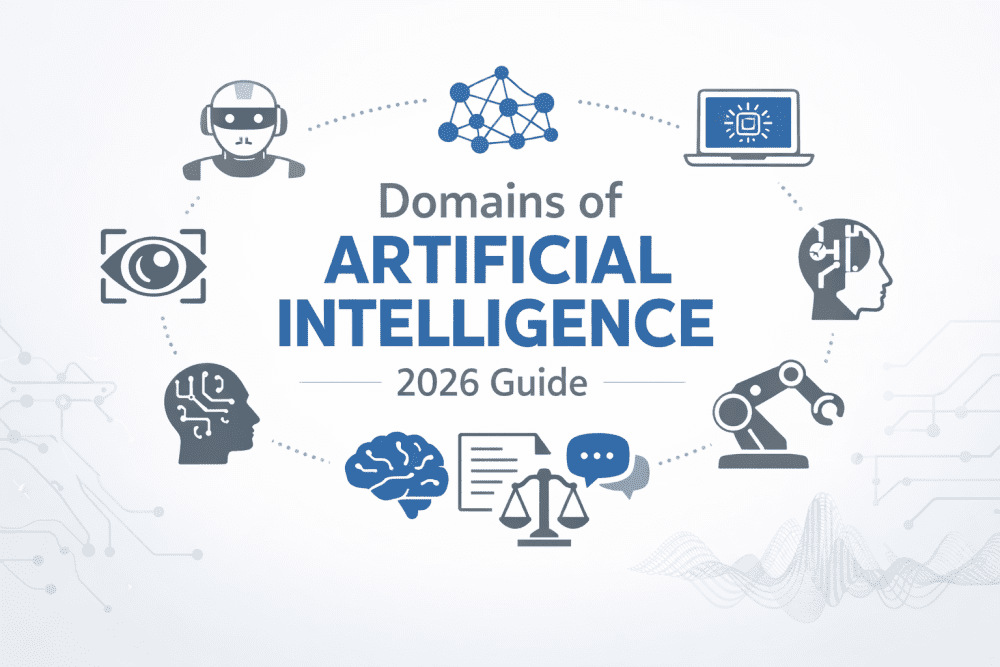
The domains of Artificial Intelligence are the core branches that define how machines perceive, learn, reason, and act. The primary domains include Machine Learning, Deep Learning, Natural Language Processing, Computer Vision, Robotics, Expert Systems, and AI Ethics & Governance, as well as emerging areas such as Neuro-Symbolic AI and Quantum Machine Learning.
Related blogs:
Why “Domains of AI” Matter in 2026
In 2026, AI is no longer a single discipline—it is an ecosystem of interconnected entities. Search engines and AI Overviews now evaluate content based on entity relationships, not keyword density. That means understanding how Machine Learning connects to NLP, how Computer Vision powers robotics, and how AI Governance regulates them all.
This guide maps the complete AI hierarchy using structured, entity-focused explanations.
1. Foundational Domains of Artificial Intelligence
These are the core disciplines that underpin modern AI systems.
1.1 Machine Learning (ML)
Machine Learning is the domain of AI that enables systems to learn patterns from data and improve without explicit programming.
Subfields:
- Supervised Learning
- Unsupervised Learning
- Reinforcement Learning
- Semi-supervised Learning
Why It Matters
Machine Learning powers recommendation engines, fraud detection systems, predictive maintenance tools, and enterprise automation platforms.
1.2 Deep Learning
Deep Learning is a subset of ML that uses multi-layered neural networks to process complex data.
Core Components:
- Neural Network Architectures
- Convolutional Neural Networks (CNNs)
- Recurrent Neural Networks (RNNs)
- Transformers
Deep Learning is responsible for breakthroughs in generative AI, speech recognition, and autonomous systems.
1.3 Natural Language Processing (NLP)

Natural Language Processing enables machines to understand, interpret, and generate human language.
Key NLP Subdomains:
- Sentiment Analysis
- Named Entity Recognition
- Machine Translation
- Conversational AI
Business Impact: NLP drives chatbots, AI assistants, document automation, and semantic search engines.
1.4 Computer Vision

Computer Vision focuses on enabling machines to interpret visual information from images and videos.
Applications:
- Object Detection
- Image Classification
- Medical Imaging
- Autonomous Driving
Computer Vision is central to healthcare diagnostics, smart surveillance, and robotics navigation.
1.5 Robotics
Robotics integrates AI with mechanical systems to enable intelligent physical actions.
Domains Within Robotics:
- Industrial Robotics
- Autonomous Vehicles
- Collaborative Robots (Cobots)
- Drone Systems
Robotics combines ML, Vision, and Control Systems to automate manufacturing and logistics.
1.6 Expert Systems
Expert systems are rule-based AI systems that emulate human decision-making.
Though less dominant than ML today, expert systems remain critical in:
- Medical diagnostics
- Legal reasoning
- Financial compliance systems
2. Applied AI Domains (Industrial AI)
Applied domains focus on sector-specific implementation.
2.1 Healthcare AI
- Computer Vision for Diagnostics
- Predictive analytics for patient risk
- AI-driven drug discovery
2.2 Generative AI in Creative Industries
- AI-generated text, video, and music
- Marketing automation
- AI-assisted design
2.3 AI in Manufacturing & Energy
- Predictive maintenance
- Asset optimization
- Digital twins
These domains show how foundational AI branches integrate into enterprise workflows.
3. Emerging Future AI Domains
In 2026, several high-intent, low-volume domains are gaining attention.
3.1 Neuro-Symbolic AI
Neuro-symbolic AI combines deep learning with symbolic reasoning to improve explainability and logical inference.
It aims to overcome the “black-box” limitations of deep neural networks.
3.2 Quantum Machine Learning
Quantum Machine Learning integrates quantum computing principles with ML algorithms to accelerate complex computations.
Still experimental, but promising in:
- Cryptography
- Drug discovery
- Financial modeling
3.3 Edge AI
Edge AI processes AI workloads directly on local devices rather than cloud servers.
Benefits:
- Reduced latency
- Enhanced privacy
- Lower bandwidth costs
Edge AI is critical for IoT devices, smart cities, and autonomous systems.
4. AI Governance & Ethics
AI is not just technical—it is regulatory and ethical.
4.1 Algorithmic Bias
AI systems may inherit bias from training data, affecting fairness in hiring, lending, and law enforcement.
4.2 Explainable AI (XAI)
Explainable AI ensures AI decisions are interpretable and transparent.
Vital for:
- Healthcare compliance
- Financial auditing
- Government AI systems
4.3 Responsible AI Frameworks
Organizations now adopt structured governance models to ensure accountability, safety, and regulatory compliance.
The AI Domain Hierarchy (2026 View)
Core Domains
→ Machine Learning
→ Deep Learning
→ NLP
→ Computer Vision
→ Robotics
→ Expert Systems
Applied Domains
→ Healthcare AI
→ Industrial AI
→ Generative AI
Emerging Domains
→ Neuro-Symbolic AI
→ Quantum ML
→ Edge AI
Oversight Layer
→ AI Governance & Ethics
Frequently Asked Questions:
What are the 7 main domains of AI?
The commonly recognized domains are Machine Learning, Deep Learning, NLP, Computer Vision, Robotics, Expert Systems, and AI Ethics.
What is the difference between Machine Learning and Deep Learning?
Deep Learning is a subset of Machine Learning that uses multi-layer neural networks, whereas ML includes broader algorithmic approaches.
Why is Natural Language Processing important for businesses?
NLP enables automation of communication workflows, sentiment analysis, customer support bots, and enterprise search.