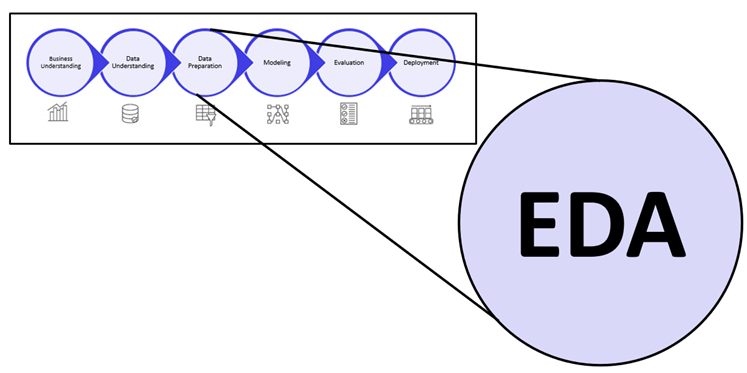
EDA in machine learning stands for Exploratory Data Analysis. It is the process of understanding, cleaning, and exploring data before building any machine learning model.
In simple terms, EDA helps you answer questions like:
- What does my data look like?
- Are there missing or incorrect values?
- Which features are related to each other?
- Are there outliers that can affect model performance?
EDA is done before feature engineering and model training to avoid the classic problem of GIGO (Garbage In, Garbage Out).
Related Blogs:
What Exactly Is EDA in Machine Learning?

EDA in machine learning is a combination of:
- Statistics (mean, median, variance)
- Visualizations (charts and plots)
- Logical checks (data types, ranges, duplicates)
The concept was introduced by John Tukey in the 1970s to encourage analysts to explore data first instead of directly applying models or formulas.
In ML, EDA helps you:
- Detect data quality issues early
- Choose the right algorithms
- Improve model accuracy and stability
Why Is EDA Important in Machine Learning?

Skipping EDA in machine learning often leads to:
- Poor model accuracy
- Biased predictions
- Overfitting or underfitting
- Wrong feature selection
Benefits of EDA:
- Understand feature distributions
- Identify missing values and outliers
- Discover hidden patterns
- Reduce trial-and-error during modeling
Good EDA = better models with less effort
The 4 Main Types of EDA

1. Univariate Non-Graphical Analysis
Focuses on one variable using numbers.
- Mean
- Median
- Mode
- Standard deviation
Example: Average salary, maximum age, minimum price.
2. Univariate Graphical Analysis
Visual analysis of a single variable.
- Histograms
- Box plots
- Bar charts
Used to understand data distribution and skewness.
3. Multivariate Non-Graphical Analysis
Looks at relationships between multiple variables using numbers.
- Correlation matrix
- Cross-tabulation
Helps identify strongly related features.
4. Multivariate Graphical Analysis
Visualizes relationships between two or more variables.
- Scatter plots
- Heatmaps
- Pair plots
Very useful for feature selection in ML models.
Step-by-Step EDA Workflow in Machine Learning
Step 1: Data Inspection
- Check dataset shape
- View first and last rows
- Understand data types
Goal: Know what data you’re working with.
Step 2: Handle Missing Values
- Remove rows (if very few)
- Replace using mean, median, or mode
- Flag missing values if important
Step 3: Outlier Detection
Outliers can heavily affect ML models.
- Use box plots
- Use IQR or Z-score methods
Step 4: Feature Relationship Analysis
- Identify correlated features
- Remove redundant variables
- Avoid multicollinearity
Step 5: Insights Before Modeling
- Decide which features to keep
- Decide whether scaling is needed
- Understand data imbalance
This completes EDA in machine learning and prepares data for modeling.
Popular Python Tools Used for EDA
| Tool | Purpose |
|---|---|
| Pandas | Data manipulation & summary |
| Matplotlib | Basic visualizations |
| Seaborn | Statistical plots |
| Pandas Profiling / Sweetviz | Automated EDA reports |
Automated EDA tools are great for quick insights, but manual EDA is still essential.
EDA vs Data Cleaning (Quick Comparison)
| Aspect | EDA | Data Cleaning |
|---|---|---|
| Purpose | Understand data | Fix data |
| Focus | Patterns & insights | Errors & inconsistencies |
| Order | First | After EDA |
| Output | Knowledge | Clean dataset |
Common Mistakes in EDA in Machine Learning

- Jumping directly to model training
- Ignoring outliers
- Trusting automated EDA blindly
- Over-cleaning data without analysis
- Ignoring class imbalance
Avoiding these mistakes can significantly improve ML results.
Frequently Asked Questions (FAQs)
Why is EDA important before model building?
EDA helps detect issues that can mislead models and improves overall prediction quality.
What are the 4 types of EDA?
Univariate non-graphical, univariate graphical, multivariate non-graphical, and multivariate graphical.
Is EDA required for every ML project?
Yes. Even small datasets benefit from EDA in machine learning.
EDA vs descriptive statistics?
Descriptive statistics summarize data, while EDA explores patterns, anomalies, and relationships.
Final Thoughts

EDA in machine learning is not optional—it is a critical foundation step.
A well-done EDA:
- Saves time
- Improves model accuracy
- Reduces unexpected errors
If you master EDA, half of your machine learning problem is already solved.