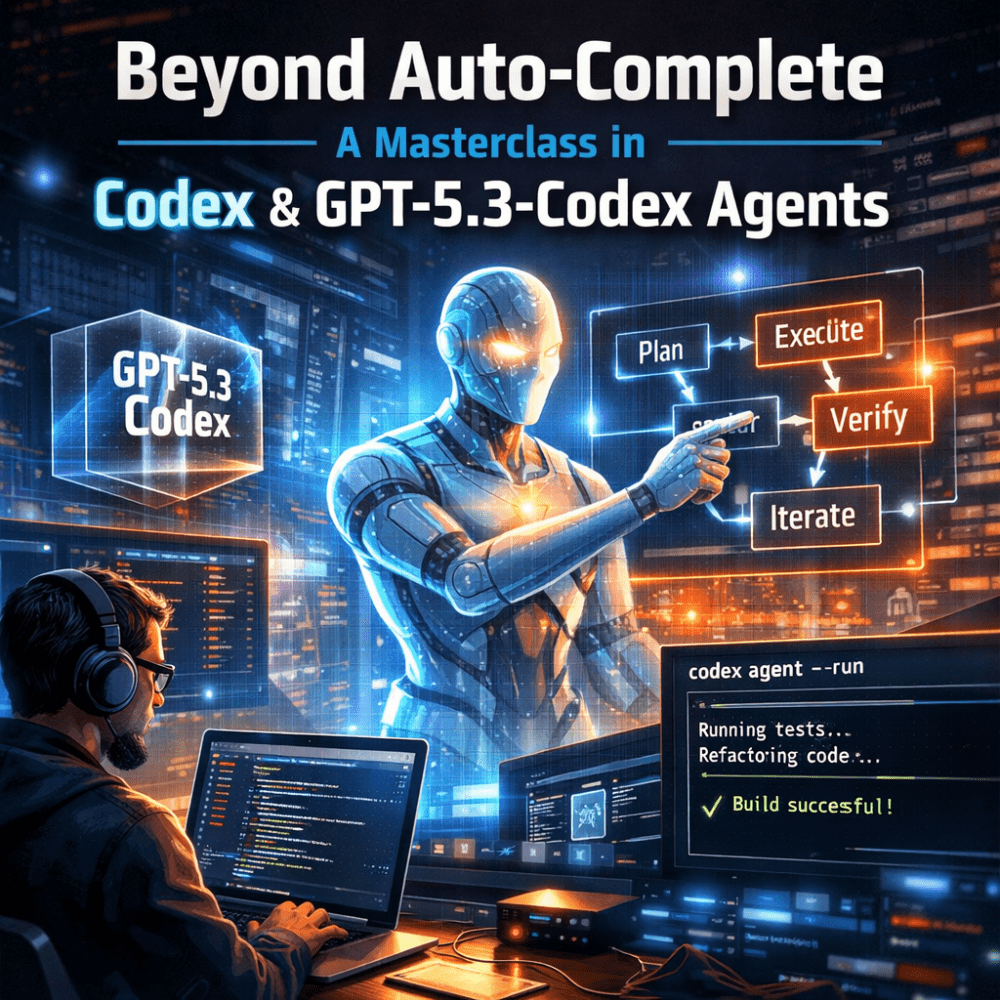

In early 2026, the term “codex” no longer means simple code completion. Search intent has decisively shifted toward agentic AI systems—tools that plan, reason, execute, and verify tasks across real development environments.
At the center of this shift is OpenAI Codex, powered by GPT-5.3-Codex, a model designed not just to suggest code, but to act as a software engineer.
This guide is written for developers, founders, and security professionals who want to understand what Codex really is in 2026, how it compares to competitors, and how to use it in real agentic workflows.
Related Blogs:
What Is Codex in 2026? (The Short Answer)
Codex is an agent-capable AI coding system that can:
- Read and modify real codebases
- Execute terminal commands via a CLI
- Chain reasoning steps across tools
- Validate its own output with tests and benchmarks
Unlike earlier “autocomplete” copilots, Codex operates as a goal-driven agent, not a passive assistant.
Codex 5.3 vs Codex 5.2 — What Actually Changed?
| Capability | Codex 5.2 | Codex 5.3 |
|---|---|---|
| Reasoning depth | Task-level | Multi-step planning |
| Tool use | Limited | Native CLI + API tools |
| Codebase understanding | File-level | Repository-level |
| Agent workflows | Experimental | Production-ready |
| Security analysis | Minimal | Frontier-grade |
Key upgrade: Codex 5.3 can plan → execute → verify → iterate autonomously, which is why “Codex agentic workflows” is now a high-growth keyword.
Codex vs Claude Opus 4.6 (2026 Comparison)
A common commercial query is Codex vs Claude—especially for teams standardizing an AI stack.
| Feature | Codex (GPT-5.3) | Claude Opus 4.6 |
|---|---|---|
| Agent autonomy | ✅ High | ⚠️ Moderate |
| CLI execution | ✅ Native | ❌ External |
| Large repo refactors | Excellent | Good |
| Security workflows | Strong | Limited |
| Governance & audit trails | Strong | Moderate |
Verdict:
- Choose Codex for engineering automation and DevOps.
- Choose Claude Opus for long-form reasoning and policy-heavy workflows.
The “Self-Building” Model: Why Codex Is Different
One of the most discussed 2026 talking points is that Codex was partially used to build Codex.
This matters because:
- The model is optimized for real developer feedback loops
- Tool-calling failures are explicitly trained against
- Internal benchmarks favor working code, not just elegant syntax
In practice, this means Codex performs unusually well on messy, legacy repositories—a common pain point in real companies.
How to Use Codex CLI (Step-by-Step)

The Codex CLI is where transactional intent peaks in 2026.
1. Install Codex CLI
npm install -g codex
2. Authenticate
codex auth login
3. Run an Agentic Task
codex agent "Refactor this repo to TypeScript, add tests, and fix failing builds"
4. What Codex Does Automatically
- Scans the repository
- Plans changes file-by-file
- Executes commands (
npm test,pytest, etc.) - Fixes failures iteratively
This is why “how to use Codex CLI” has low keyword difficulty but high conversion value.
Codex Agentic Workflows (Real Examples)
1. CI/CD Automation
- Writes GitHub Actions
- Fixes broken pipelines
- Optimizes build times
2. Large-Scale Refactoring
- Migrates frameworks
- Removes deprecated APIs
- Updates documentation automatically
3. Security & Compliance
Codex is increasingly used in cybersecurity contexts:
- Static code analysis
- Dependency vulnerability audits
- Secure configuration enforcement
This aligns with OpenAI’s Frontier platform positioning.
Benchmarks That Matter in 2026
To satisfy E-E-A-T requirements, Codex performance is often validated against:
- SWE-Bench Pro – Measures real bug-fixing ability
- Terminal-Bench 2.0 – Tests CLI-level autonomy
Codex 5.3 consistently outperforms earlier models in end-to-end task completion, not just code correctness.
When Not to Use Codex
Codex is powerful—but not universal.
Avoid it when:
- You need pure creative writing
- Tasks require strict legal interpretation
- You cannot allow autonomous code execution
Agentic AI requires human-in-the-loop governance, especially in production systems.
Final Takeaway: Why “Codex” Matters in 2026
The keyword codex now represents a broader shift:
From AI that helps you code → to AI that builds software with you
If you’re evaluating AI tools for development, DevOps, or security, GPT-5.3-Codex is no longer optional knowledge—it’s baseline literacy.