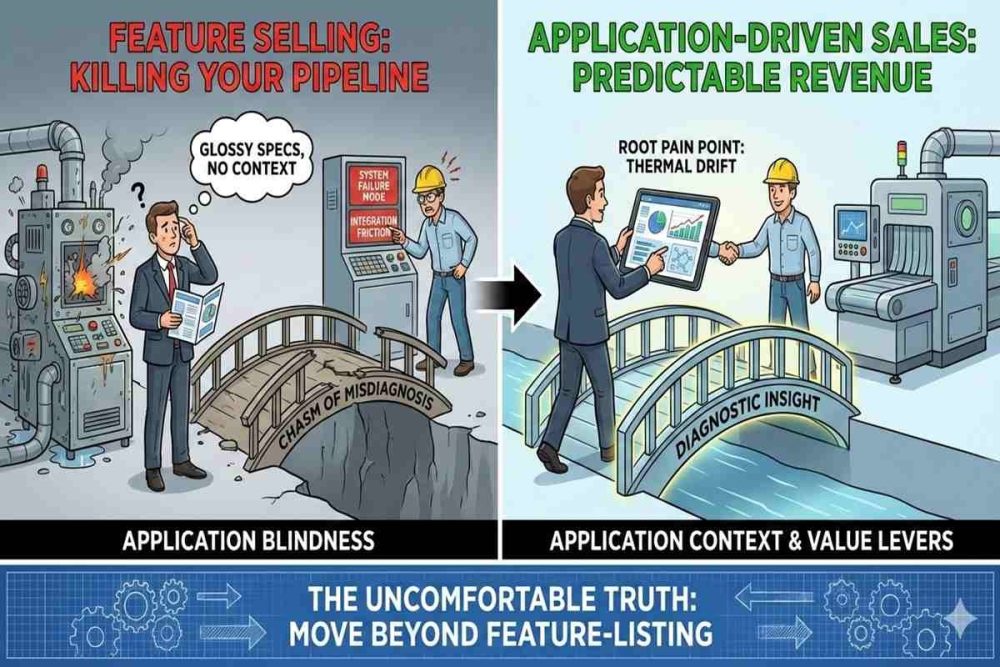
The hard truth of technical B2B sales pain points is this: most complex sales cycles fail not because of a competitive feature gap or a marginal price difference, but because the seller fundamentally misdiagnosed the customer’s problem. We spend millions on sales enablement, yet the chasm between product capability and the customer’s actual decision logic remains vast.
The product team builds a marvel of engineering; the sales team sells a brochure. This article is your blueprint for closing that gap. We will explain how high-performing technical B2B sales organizations move beyond feature-listing to uncover real, application-level pain points, converting that deep insight into predictable, high-margin revenue.
1. The Core Problem: Feature Selling vs. Application Reality
In the industrial and high-tech sectors, specifications, glossy brochures, and generic value propositions are not just ineffective—they are actively detrimental. They signal a lack of understanding, immediately eroding trust with the technical buyer.
The root cause is application blindness: the seller’s inability to articulate how their product will fail, degrade, or create complex trade-offs within the customer’s specific, real-world use case. The customer is not buying a component; they are buying a solution to a problem that exists within a system.
The consequences of this blindness are systemic:
- Longer sales cycles: Because the buyer has to educate the seller.
- Distrust from engineers: Because the seller speaks in marketing-speak, not engineering language.
- Commoditization pressure: Because without application context, your product is just a spec sheet, easily compared to the next.
Your value to the reader is simple: you are giving them the clear, diagnostic language to use internally to identify and fix this failure mode.
2. What “Real Pain Points” Actually Look Like in Industrial Markets
A surface pain point is what the customer tells you: “Your solution is too expensive.” A root pain point is the underlying technical reality that makes them say it.
True technical pain points are defined by system-level failure modes, not budgetary constraints. They include:
- Performance instability: The component drifts out of spec under load.
- Integration friction: The physical interface requires excessive engineering time to deploy.
- Environmental constraints: The sensor fails prematurely due to humidity or vibration.
- Maintenance and lifecycle costs: The required recalibration or replacement schedule destroys the total cost of ownership.
For example, a buyer doesn’t care that your sensor has 0.01% better accuracy; they care that the competitor’s sensor suffers from thermal drift, which causes costly recalibration in their manufacturing line. Buyers reward sellers who speak in failure modes, because failure modes are the language of risk, and technical buyers are fundamentally risk managers.
3. Why Traditional Sales Intelligence Tools Fall Short
The current toolkit for sales intelligence is built for a simpler era.
- CRM: Tracks people, tasks, and deal stages, not the underlying technical problems being solved. It’s a ledger of activity, not a repository of insight.
- Market research: Too abstract, lagging, or based on aggregated opinions. It tells you what is happening in the market, but rarely why it matters to a specific application.
- Customer interviews: Inherently biased toward existing customers and existing problems. They reveal the known-knowns, not the market-wide reality of the unknown-unknowns.
The uncomfortable truth is that most technical sales teams guess pain points and call it “experience.” They rely on the tribal knowledge of a few veteran engineers, a resource that is neither scalable nor repeatable.
4. A Better Model: Application-Driven Sales Intelligence
The future of high-performance technical B2B sales lies in a systematic approach we call Application-Driven Sales Intelligence. This is the missing layer between product knowledge and customer interaction.
The framework is a simple, yet powerful, mapping exercise:
Mapping Applications → Pain Points → Constraints → Value Levers
This approach forces the sales organization to think like an engineering consultancy. It requires understanding the application context – the physics, the regulations, the trade-offs – before ever presenting a feature. This systematic approach to uncovering technical pain points is what separates market leaders from the pack.
The benefits are immediate and compounding:
- Faster qualification: You instantly filter out prospects who don’t have the specific pain you solve.
- Higher trust with engineers: You speak their language of risk and trade-offs.
- Clearer differentiation: Your value proposition is tied to solving a specific, costly failure mode, not a generic feature.
This is not a product pitch; it is a reusable mental framework that your team can apply immediately to re-architect your sales process.
5. How High-Performing Teams Operationalize This Today
The most successful technical teams have always done this, but they do it manually, at immense cost. Their practical methods include:
- Mining patents and technical literature: Systematically studying how competitors and adjacent technologies have solved (or failed to solve) specific application problems.
- Studying competitive failure modes: Dissecting why a competitor’s product fails in the field to understand the true technical constraints of the application.
- Building internal “pain libraries”: Creating a structured, searchable repository of every technical pain point encountered, categorized by application, industry, and component type.
The trade-offs are obvious: this is time-intensive, hard to scale, and dependent on the availability of a few expert engineers. This section builds the necessary tension: the methodology is proven, but the manual execution is a bottleneck.
6. Where Platforms Like GrowthBeaver Fit In
This is where the systematic approach of platforms like GrowthBeaver enters the conversation. They exist not to replace your sales team, but to systematize the high-effort, manual research that top teams already attempt.
GrowthBeaver is an example implementation of Application-Driven Sales Intelligence. It works by:
- High-level function: Systematically aggregating and structuring application-level pain point intelligence across broad vertical markets.
- Target audience: Technical B2B sales leaders, sales engineers, and business development teams selling complex components (sensors, actuators, semiconductors).
- Core value: It exists to scale and systematize the process of understanding customer pain point modes, turning tribal knowledge into a repeatable, competitive asset.
The platform allows you to move from guessing pain points to diagnosing them with data, ensuring that every sales conversation is grounded in the customer’s technical reality.
7. When This Approach Is Overkill (And When It’s Not)
Let’s be brutally honest: Application-Driven Sales Intelligence is not for everyone.
It is overkill for transactional, low-complexity sales where the product is a drop-in replacement and the decision criteria are purely price and availability.
It is critical for high-ticket, engineered, long-cycle deals. Use this simple decision checklist to determine if this strategic shift is necessary:
- Is custom engineering or integration involved?
- Does the buyer group include technical stakeholders (engineers, R&D)?
- Are your sales cycles typically longer than three months?
If you answered “Yes” to any of the above, your sales success is directly correlated with your depth of application understanding. This honesty builds credibility and trust with the discerning technical audience.
8. Practical Takeaways Readers Can Apply Immediately
You don’t need a new tool to start. You need a new mindset. Here are five concrete actions you can implement today:
- Rewrite one pitch: Take your best-selling product and rewrite the pitch entirely around a specific application failure mode it prevents, instead of a feature it possesses.
- Add “application context” to qualification: Make it mandatory to document the customer’s specific operating environment and technical trade-offs during the first call.
- Audit CRM fields: Create a new custom field in your CRM called “Root Technical Pain” and make it a required field before moving to the proposal stage.
- Align sales and engineering vocabulary: Host a joint session where sales engineers teach the sales team the top five failure modes of your competitors’ products.
- Test pain-point-driven content: Create a single piece of content (a blog, a whitepaper) that focuses exclusively on diagnosing a technical problem, not promoting a product.
9. Conclusion: The Strategic Shift Most Teams Delay Too Long
The core insight remains: technical buyers do not buy products; they buy trust and understanding. They buy the confidence that you grasp the complexity of their world better than they do.
Positioning application-driven pain intelligence as a competitive moat, not a mere tool trend, is the strategic shift most organizations delay too long. The teams that systematize this deep, technical understanding will inevitably outcompete those who continue to rely on generic decks, and the hope that their product’s specs will speak for themselves. The future of technical B2B sales is not about selling features; it’s about selling the diagnosis.
Looking for Travel Inspiration?
Explore Textify’s AI membership