Have you come across the term Named Entity Recognition or NER? If not, we will help you! Let’s begin with the definition first. NER is the process of identifying and classifying named entities in Natural Language Processing or NLP. NER further has three subtasks. These include entity names, temporal expressions and quantities. Entity names are distinct real-world identifiers, such as names of people, organizations and locations. Temporal expressions denote time and date, and quantities denote percentages and monetary values, among others.
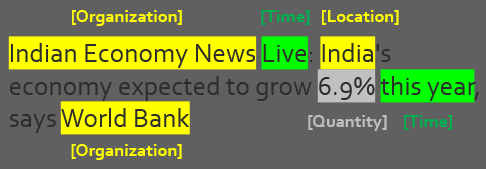
Named Entity Recognition has various applications. Some of them include information extraction from text, storing data in a database, classifying content, summarization, etc.
An NER model typically consists of three blocks. The first one is an identification module that identifies the entities with the help of POS tagging and dependency parsing. The next one includes a classification module that classifies the entities into locations, people, time or quantities. The third one is a module disambiguates the entities. For example, Washington is ambiguous. However, depending on the context, the entity can either be a city or a person.
Four Approaches of Named Entity Recognition
Named Entity Recognition or NER mainly uses four approaches. These are based on lexicons, use rule-based methods, use machine learning and are deep learning based.
- Lexicons contain semantic and grammatical information about words or word strings. This information can be used to identify named entities.
- Rule-based methods make use of a dictionary of rules that help identify the entities.
- Machine learning models for NER can be both, classification and regression.
- For deep learning models, bidirectional Long Short-Term Memories (LSTMs) are used.
We hope we could explain the concept of NER in a crisp and smooth manner. Stay updated with our blog section for more such technical information. We keep filling the knowledge bank every week with the latest information related to Artificial Intelligence and Natural Language Processing.

