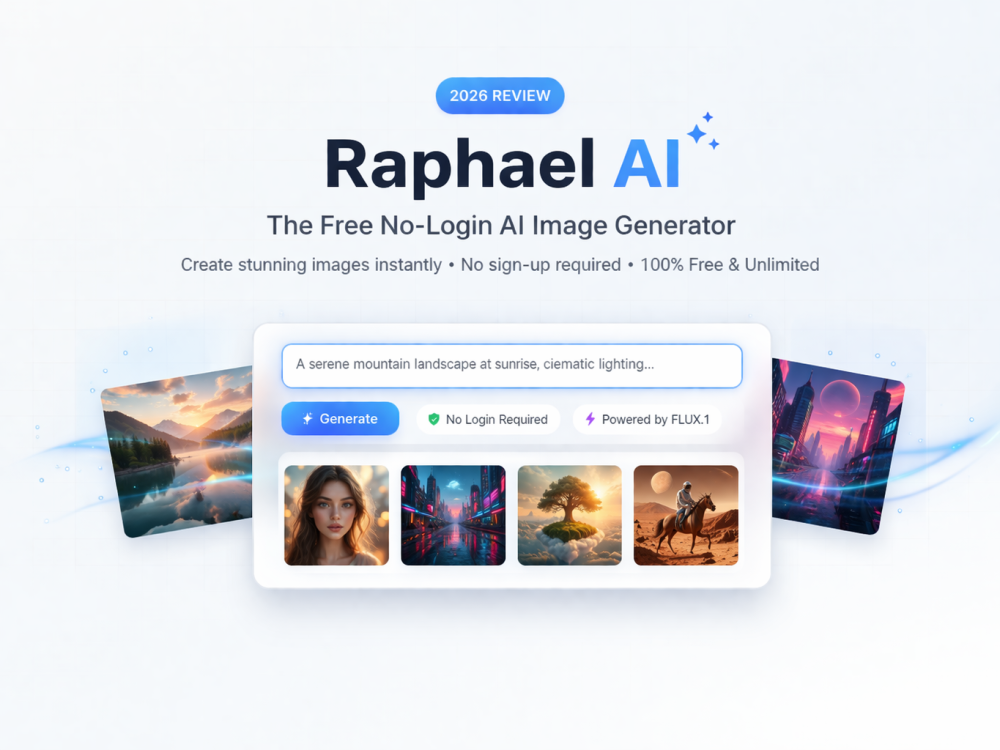
Introduction: Why This Tool Is Getting Attention
AI image generation tools are evolving rapidly, but most still require accounts, subscriptions, or usage limits. That friction creates an opportunity for tools focused on simplicity and accessibility.
Raphael AI stands out by offering:
- Instant access without registration
- Unlimited generations
- A privacy-first experience
Because of this positioning, it appeals strongly to beginners, marketers, and creators who need quick outputs without commitment.
Related blogs:
Core Features and Capabilities
Instant Access Without Barriers
Unlike many competitors, this tool removes onboarding friction. Users can start generating visuals immediately, which improves usability and reduces drop-off.
Modern Model Performance
It uses advanced models such as FLUX.1, enabling:
- Better prompt interpretation
- Improved detail and lighting
- More consistent visual outputs
Privacy-Focused Approach
Another key advantage is its strict privacy stance:
- No prompt storage
- No tracking mechanisms
- No user accounts
As data concerns grow in 2026, this becomes a meaningful differentiator.
How to Generate Images Efficiently

To get the best results, follow a structured approach:
Step 1: Write a Detailed Prompt
Clear prompts improve output quality. For example:
“A cinematic cyberpunk street, neon lights, rainy atmosphere, ultra-realistic, 8K”
Step 2: Add Style Modifiers
Enhance results by including terms like:
- Cinematic lighting
- Photorealistic
- Digital painting
Step 3: Generate and Evaluate
Run the prompt and review the output. If needed, refine wording for better precision.
Step 4: Iterate Quickly
Because there are no limits, experimentation becomes easy and efficient.
Advantages and Limitations
| Advantages | Limitations |
|---|---|
| Free and unlimited usage | Limited advanced controls |
| No login required | Less consistent outputs |
| Fast generation speed | Fewer customization settings |
| Strong privacy protection | Not ideal for complex workflows |
Comparison With Leading Tools
When compared with established platforms like Midjourney, Leonardo AI, and Stable Diffusion, clear differences emerge.
Ease of Use
This tool is significantly simpler. There is no setup, which makes it ideal for quick tasks.
Output Quality
Midjourney still leads in artistic quality, while Stable Diffusion offers deeper customization. However, the gap is narrowing for general use cases.
Flexibility
Advanced users may prefer tools with parameter tuning, model selection, and fine control.
Privacy and Security Considerations
One of the most compelling aspects is its privacy-first architecture. Since no login is required, there is minimal exposure of personal data.
Additionally:
- Prompts are not retained
- Outputs are not linked to users
- Sessions remain anonymous
For users concerned about data usage, this is a strong advantage over many alternatives.
Ideal Use Cases
This tool performs best in scenarios where speed and simplicity matter:
- Creating blog visuals for SEO
- Generating social media content
- Rapid prototyping of ideas
- Learning prompt engineering basics
However, for production-grade design pipelines, more advanced tools may be necessary.
Alternatives Worth Considering
Depending on your needs, these options may provide additional capabilities:
- Midjourney for premium artistic results
- Leonardo AI for structured workflows
- Stable Diffusion for full customization
Each serves a different segment of the AI art ecosystem.
Final Assessment
For users prioritizing speed, accessibility, and privacy, Raphael AI delivers strong value. While it does not replace high-end tools, it fills a critical gap in the market.
In practical terms, it is best viewed as:
- An entry-level AI generator
- A rapid content creation tool
- A privacy-conscious alternative
FAQs:
Is Raphael AI free to use?
Yes, it allows unlimited image generation without requiring payment or registration.
Does it store user data?
No, it follows a zero data retention approach.
How does it compare to Midjourney?
It is easier to access but offers less control and slightly lower output quality.
Who should use it?
Beginners, marketers, and anyone needing fast, simple AI-generated visuals.